
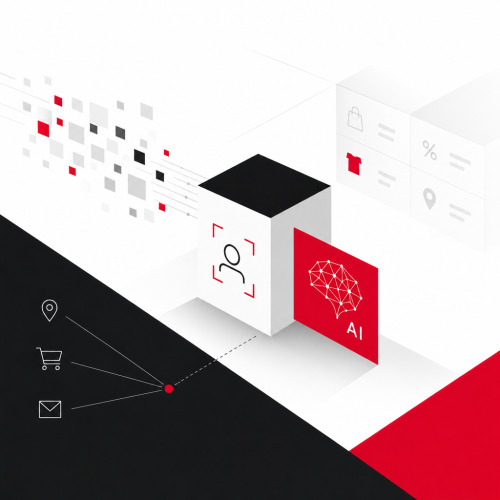

Hyperpersonalization is no longer a trend, it's the new baseline for competitive marketing. Real-time AI personalization, marketing automation at the individual level, and personalized advertising without traditional customer segmentation: What this specifically means and where the development is heading is shown in this article.
The technological prerequisites are now available for companies of all sizes. What is often missing is an understanding of where hyperpersonalization specifically applies in online marketing and what it can actually deliver.
What is hyperpersonalization and what has changed?
Hyperpersonalization refers to the ability to customize content, offers, and experiences for each individual user in real-time. The crucial difference from traditional customer segmentation: Instead of addressing groups with similar characteristics, hyperpersonalization addresses each person based on their current behavior, context, and preferences.
McKinsey estimates that hyperpersonalization can generate up to 40% more revenue for companies in high-growth industries compared to less personalized competitors. What was previously reserved for technology giants like Amazon or Netflix is now becoming scalable for medium-sized companies through more accessible AI infrastructure and decreasing costs for machine learning models.
What is hyperpersonalization? Hyperpersonalization uses real-time data, artificial intelligence, and machine learning to deliver individually tailored content, offers, and experiences to each user across all channels, far beyond traditional customer segmentation by demographic or behavioral groups.
Why has AI personalization replaced traditional customer segmentation?
Traditional customer segmentation divides target groups into clusters by age, location, purchase history, or interests. The problem: Even precise segments describe groups, not individuals. A 35-year-old mother in Munich and a 35-year-old manager in Hamburg fall into the same segment, but have fundamentally different needs, purchase intentions, and contexts.
AI personalization overcomes this limitation by reacting to hundreds of signals simultaneously in real-time: which page is currently being visited, how long someone scrolls, what was previously purchased, which device is being used, and at what time of day the interaction takes place. Market research consistently shows that the vast majority of consumers now expect companies to understand their individual needs and expectations.
What technological leaps are making hyperpersonalization possible today?
Three technological developments have taken hyperpersonalization to a new level in recent years:
- Large Language Models (LLMs): GPT-4, Claude, and comparable models enable the automatic generation of personalized texts, product descriptions, and recommendations in natural language for the first time, in real-time and at scale.
- Customer Data Platforms (CDPs): Modern CDPs aggregate first-party data from CRM, website, app, and offline channels into a unified customer profile and make it available for AI models in real-time.
- Edge Computing: Moving computing power closer to the user reduces latency to milliseconds, a prerequisite for real-time personalization that actually works in real-time.
How AI agents independently make decisions and control marketing processes is explained in our article on Agentic Marketing. The appropriate technical foundation for this is provided by a modern marketing data stack.
What trends are currently shaping hyperpersonalization?
The market is moving quickly. Five trends define where hyperpersonalization will develop in the coming years:
-
Predictive Personalization: AI models anticipate needs before users articulate them themselves. Amazon reports that a significant portion of its total revenue comes directly from personalized recommendations based on purchase history and similar user profiles. This model is increasingly being transferred to smaller companies.
-
Agentic Marketing Automation: AI agents no longer just deliver personalized advertising, they plan, test, and optimize entire campaigns autonomously. Gartner predicts that by 2028, at least 15% of all daily work decisions will be made autonomously by AI agents. Marketing is a leading sector here.
-
Zero-Party Data as Personalization Basis: With the end of third-party cookies, data that users actively and voluntarily share moves to the center. Forrester Research demonstrates that brands with consistent zero-party data strategies achieve significantly higher engagement rates than those based on implicitly collected data.
-
Multimodal Personalization: Text, image, video, and audio are individualized simultaneously. Netflix personalizes not only recommendations but also thumbnails: The same series appears with completely different preview images for different user types, based on individual viewing behavior.
-
Privacy-Compliant Hyperpersonalization: GDPR and the EU AI Act force companies to design personalization transparently and based on consent. This requires, among other things, a GDPR-compliant tracking setup, which is not a contradiction to hyperpersonalization, but a prerequisite for sustainable trust.
How does hyperpersonalization change specific marketing disciplines?
The effects of hyperpersonalization are not abstract, they are already fundamentally transforming specific disciplines and channels today.
How is personalized advertising changing through AI personalization?
Traditional personalized advertising is based on segments: remarketing lists, lookalike audiences, and demographic targeting groups. AI personalization goes significantly further, it responds to individual signals in real-time and optimizes creatives, copy, and placement for each individual user.
Meta reports that campaigns with AI-powered Advantage+ Shopping Campaigns achieve a significantly lower cost-per-purchase on average than manually controlled campaigns. Google Performance Max shows similar patterns. The system automatically combines assets into individually optimized ad variants per user.
What does hyperpersonalization mean for content marketing?
Static content that is identical for all visitors is losing relevance. Hyperpersonalization in content marketing means: The homepage shows different content to first-time buyers than to regular customers. The newsletter contains different product recommendations for each recipient. Blog articles are dynamically supplemented with relevant content.
Personalized calls-to-action perform significantly better than static, generic variants according to consistent market observations. Hyperpersonalization takes this effect to a new dimension.
How is email marketing being redefined by marketing automation?
Email marketing was the first discipline to enable scaled personalization. Modern marketing automation goes far beyond first-name personalization: sending time, subject line, product recommendations, layout, and even language are individually customized.
Studies consistently show that consumers are more likely to buy from companies that provide personalized experiences. Email campaigns with dynamic content achieve measurably higher open and click rates compared to non-personalized campaigns.
| Marketing Discipline | Before Hyperpersonalization | With Hyperpersonalization |
|---|---|---|
| Personalized Advertising | Segment-based targeting | Individual real-time optimization per user |
| Email Marketing | Segmented campaigns | Fully dynamic content per recipient |
| Website/Landing Page | Uniform experience | Individualized content, recommendations, CTAs |
| Content Marketing | Static articles | Dynamic content blocks by user profile |
| Customer Segmentation | Group addressing | 1:1 communication at individual level |
Which companies are already successfully implementing hyperpersonalization today?
Three companies have made hyperpersonalization a core competency and show what is possible for other industries:
Amazon is the best-known benchmark: The recommendation system analyzes purchase history, search behavior, dwell time, and comparison purchases of other users with similar profiles. A considerable portion of total revenue comes directly from personalized recommendations. The principle: Not showing the most popular products, but those most relevant to this user.
Netflix personalizes on over 40 different levels simultaneously: title recommendations, order, thumbnails, description texts, and even preview clips. The overwhelming majority of viewed content comes from personalized recommendations, the result of years of AI personalization based on data from over 280 million subscribers.
Spotify uses listening data, time of day, mood patterns, and geographic contexts to generate playlists like "Discover Weekly" fully automated and individually. Users who use personalized playlists demonstrably listen longer, a direct connection between personalization depth and user retention.
What can B2B companies learn from B2C players?
B2B marketing still lags significantly behind B2C in hyperpersonalization, even though the levers are comparable. Forrester Research shows that only 22% of B2B companies use personalization beyond the level of customer segmentation. Yet the effect in the B2B context is often even greater: Personalized account-based marketing campaigns achieve significantly higher engagement rates than non-personalized outreach approaches according to consistent market observations.
Calculation example: Conversion gain through hyperpersonalization:
An e-commerce company with 500,000 monthly visitors and an average conversion rate of 2.5% achieves 12,500 purchases per month. With an average cart value of €85, this corresponds to a monthly revenue of €1,062,500.
Hyperpersonalization increases the conversion rate by 10 to 15% according to McKinsey benchmarks:
| Scenario | Conversion Rate | Monthly Purchases | Monthly Revenue | Difference |
|---|---|---|---|---|
| Without Hyperpersonalization | 2.5% | 12,500 | €1,062,500 | - |
| With Hyperpersonalization (+10%) | 2.75% | 13,750 | €1,168,750 | +€106,250 |
| With Hyperpersonalization (+15%) | 2.875% | 14,375 | €1,221,875 | +€159,375 |
With a conservatively estimated annual uplift of 10%, this results in additional annual revenue of over €1.2 million with constant traffic.
What does hyperpersonalization mean for data protection and ethics?
Hyperpersonalization and data protection are often portrayed as contradictions. They are not, but they require a clear framework.
Where is the line between relevance and intrusiveness?
The difference between helpful and intrusive lies in transparency and control options. Users who know what data is being collected and have the ability to control or delete it perceive personalization much more positively than those who feel they are being monitored.
Studies consistently show that consumers are more likely to buy from brands that recognize them and provide relevant recommendations, but only if they feel they maintain control over their data.
How does GDPR-compliant AI personalization work in practice?
GDPR-compliant hyperpersonalization is based on three basic principles:
- Consent-based data collection: Only data for which informed consent for collection and use exists may be used for personalization.
- Data minimization: Only the data that is actually necessary for the defined personalization purpose is collected and processed.
- Transparency and control: Users must be able to view, delete, or correct stored data at any time.
The 3 ethical guidelines for hyperpersonalization:
- Relevance instead of intrusiveness: Personalization serves the user, not exclusively the company's conversion goal.
- Transparency as prerequisite: Users know why they see a recommendation and can object.
- Data minimization as standard: As much personalization as necessary, as little data collection as possible.
The EU AI Act, which has been gradually coming into force since 2024, classifies AI systems that could manipulate user behavior as high-risk and thus places new requirements on AI-powered personalization systems. Companies that now invest in transparent data practices create a regulatory future-proof foundation that also secures the EU AI Regulation in the long term.
What do companies need to do now before hyperpersonalization becomes standard?
The time to strategically address hyperpersonalization is now. Five measures help to proceed in a structured way:
-
Build a first-party data strategy: With the elimination of third-party cookies, own customer data is the only reliable basis for AI personalization. CRM, website analytics, email engagement, and purchase data must be consolidated and structured. A modern marketing data stack is essential here.
-
Test AI personalization on a small scale: Don't rebuild the entire marketing stack immediately, instead select one channel, define a use case, and start with measurable KPIs. Why the iterative approach to AI projects is almost always superior and which prerequisites really matter is explained in our article on AI initiatives and their real bottlenecks.
-
Build marketing automation as scaling infrastructure: Hyperpersonalization without automation is not scalable. Marketing automation handles the delivery, testing, and optimization of personalized content and is thus the technical prerequisite, not the luxury.
-
Consider data protection compliance from the start: GDPR-compliant consent structures, transparent data practices, and clear opt-out options are not a burden, they are both a trust basis and competitive advantage.
-
Build internal competence: Hyperpersonalization requires collaboration between marketing, IT, and data science. Companies that establish cross-functional teams early are better positioned in the long term than those that treat personalization as a purely IT project.
Conclusion
Hyperpersonalization is no longer a future vision, it is the present for those companies that understand marketing as a data-driven discipline. The crucial difference from traditional customer segmentation does not lie in technology alone, it lies in the strategic decision to treat each user as an individual and not as a member of a group.
Would you like to know how hyperpersonalization specifically fits into your company and what first steps are realistically feasible? We would be happy to analyze this together in a free initial consultation, non-binding and tailored to your specific situation.